Sound Investments: Why Acoustic Performance Belongs in Every Building Budget From Day One

Photo: Neil Owen , CC BY-SA 2.0, via Wikimedia Commons
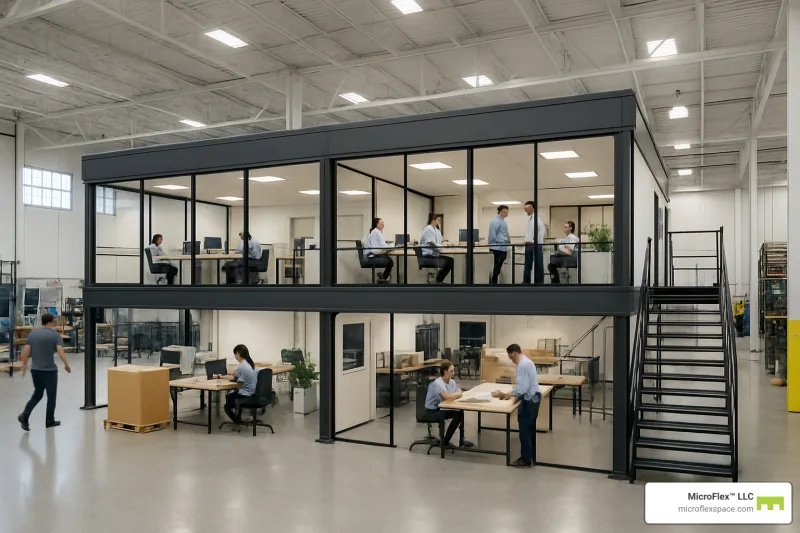
There is a particular kind of regret that settles over a facilities team approximately six weeks after move-in. The furniture is in place, the signage is mounted, and the leadership team has already sent the congratulatory all-staff email. Then the complaints begin. Too loud. Can't concentrate. Conference calls are impossible. The open floor plan that looked so promising in the renderings has become, in practice, a daily exercise in distraction.
Acoustic failure is one of the most predictable problems in commercial architecture—and one of the least likely to be caught before construction begins. Unlike mechanical systems or envelope performance, sound management rarely appears as a dedicated line item in preliminary budgets. It tends to surface instead as a vague aspiration: "we'll add some soft surfaces" or "the ceiling tiles should help." By the time the building is occupied and the problem is measurable, the cost of meaningful remediation has multiplied several times over.
This is not a minor inconvenience. It is an operational liability, and the design industry has not done enough to help clients understand the difference.
The Gap Between Specification and Experience
Acoustic design occupies an uncomfortable middle ground in most commercial projects. It is technical enough to require specialized expertise, yet it is often treated as a finishing consideration rather than a structural one. In competitive bid environments, acoustic specifications are among the first elements to be value-engineered out of a project. The consequences are rarely visible at the time of the cut—and are almost always visible after occupancy.
The underlying physics are not complex. Sound travels through air and through structure. Open-plan environments amplify both pathways. When a space lacks adequate absorption, diffusion, and isolation, speech intelligibility collapses, background noise levels rise, and the cognitive load placed on occupants increases substantially. Workers in acoustically poor environments spend measurable energy simply filtering out ambient sound—energy that would otherwise be directed toward the work itself.
Research consistently supports what most office workers already know intuitively. Studies conducted across a range of American workplaces have found that noise ranks among the top complaints affecting employee satisfaction and self-reported productivity. The figures are not marginal. In some surveys, more than half of respondents identify noise as a significant impediment to focused work. The correlation between acoustic quality and employee retention, while harder to quantify directly, is increasingly difficult to dismiss.
What Good Acoustic Design Actually Requires
Effective acoustic performance in a commercial building is not a single intervention. It is a layered system, and each layer must be considered in relation to the others.
Absorption addresses the reflective surfaces that allow sound to bounce and accumulate. This includes ceiling systems, wall panels, flooring materials, and soft furnishings—but the selection of these elements must be driven by acoustic coefficients, not merely aesthetic preference. A ceiling tile that looks similar to a high-performance alternative may absorb a fraction of the sound energy. That distinction rarely appears in a schematic design presentation.
Isolation governs the transmission of sound between spaces. Conference rooms that lack adequate wall construction, proper door seals, and decoupled mechanical penetrations will bleed sound into adjacent areas regardless of what happens inside them. The investment required to build meaningful isolation into a partition system during construction is a small fraction of what it costs to address the same problem through retrofitted panels or relocated teams after occupancy.
Masking, often delivered through a distributed sound system that introduces a consistent ambient signal, raises the threshold at which speech becomes intelligible across a space. When properly calibrated, a masking system makes nearby conversations less distracting without making the environment feel artificially loud. It is one of the most cost-effective acoustic tools available—and one of the most frequently omitted from initial specifications.
Finally, spatial planning itself is an acoustic instrument. Where teams are located relative to one another, how circulation paths are routed, and where high-activity areas like reception and collaboration zones are positioned all affect the acoustic character of the finished environment. These decisions are made early in the design process. Revisiting them after construction is not an option.
The Cost Calculus of Waiting
The financial argument for treating acoustic performance as infrastructure rather than afterthought is not subtle. Retrofitting a poorly performing open-plan floor typically involves a combination of added ceiling baffles, freestanding panels, sound masking installation, and in some cases, partial reconstruction of enclosed spaces. Costs vary significantly by market and building condition, but it is not unusual for post-occupancy acoustic remediation to run into six figures for a mid-sized floor plate—without fully resolving the underlying problem.
Contrast that with the cost of integrating acoustic thinking from the outset. When absorption, isolation, masking, and spatial planning are specified together during design development, the incremental cost over a baseline specification is modest. More importantly, it is a known cost—one that can be evaluated, adjusted, and approved before a single wall is framed.
There is also the question of human cost, which does not appear on a construction budget but absolutely appears on a payroll. Employees who cannot work effectively in their environment do not simply tolerate the condition silently. They seek accommodations, work from home more frequently, or eventually seek employment elsewhere. For organizations that have invested heavily in workplace design as a tool for culture and collaboration, a building that undermines concentration is a direct contradiction of that investment.
Treating Acoustics as Operational Infrastructure
The firms and organizations that handle this well share a common orientation: they treat acoustic performance the way they treat HVAC performance. Not as a luxury upgrade or a design flourish, but as a functional requirement that must be specified, verified, and maintained.
This means engaging acoustic consultants early—during schematic design, not during construction documents. It means establishing measurable performance targets, such as noise criteria ratings and speech transmission index values, that can be tested after construction is complete. And it means holding those standards through the value-engineering process, recognizing that acoustic cuts made in the interest of short-term savings tend to produce long-term operational costs that dwarf the original reduction.
At COO Architecture, the premise that guides our work is that a building's true performance is measured not at ribbon-cutting but across the years of use that follow. Sound is experienced every hour of every workday. It shapes how people feel in a space, how effectively they can think, and ultimately how they regard the organization that put them there.
Budgeting for acoustic performance is not an act of generosity toward future occupants. It is an act of operational discipline—and it is one of the clearest signals that a client understands what a building is actually for.